Of everything red light gets used for, hair has the longest research history. Low-level laser therapy has been studied for pattern hair loss for decades, and dermatology uses red light for hair growth more than for any other purpose. Here is what the evidence actually shows, minus the before-and-after hype.
How light is thought to affect hair follicles
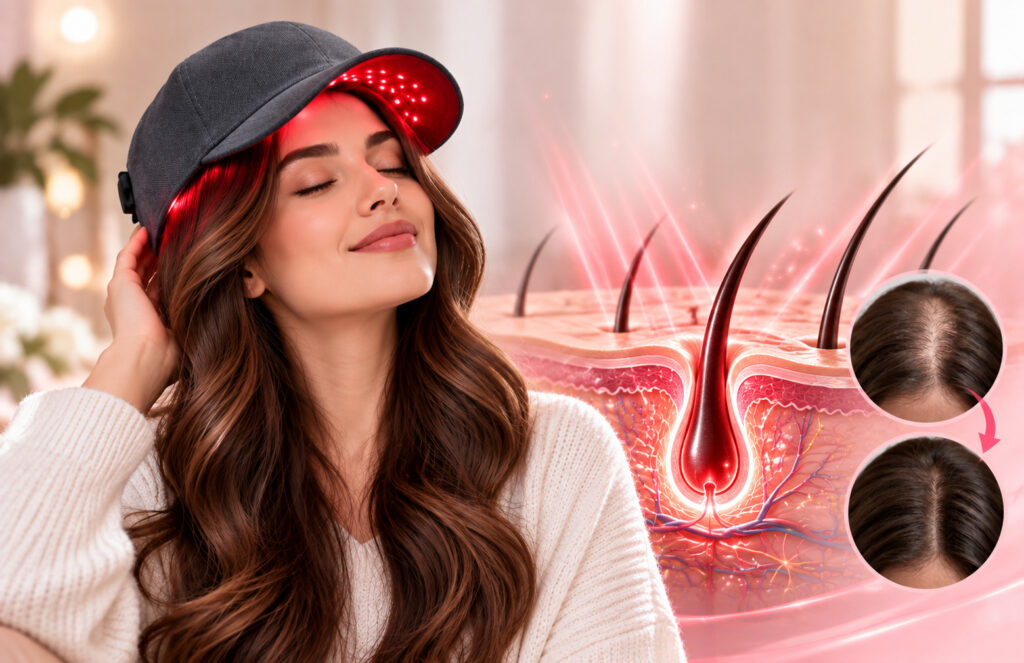
Red and near-infrared light applied to the scalp is absorbed by cells in and around the hair follicle. The proposed mechanism involves increased cellular energy production, nitric oxide release and anti-inflammatory signalling, which appear to support the dermal papilla cells that drive the hair growth cycle. In practical terms, the aim is to move more follicles into, and keep them in, their active growing phase.
What the trials found
A systematic review and meta-analysis covering 37 studies and around 3,300 patients found that low-level laser therapy produced a mean increase in hair density of roughly 18.5 hairs per square centimetre compared with sham devices, along with a small increase in hair shaft thickness. The same analysis found that combining low-level laser therapy with minoxidil produced better density results than minoxidil alone.
A real-world study following 1,383 users of an FDA-cleared laser helmet reported an overall clinical effectiveness rate close to 80 percent, with most users in the 18 to 40 age range and median use running roughly 38 to 40 weeks. That number is worth reading carefully: it comes from real-world use rather than a controlled trial, and the treatment period was long.
The honest summary: the effect is real but modest, it is best documented in androgenetic alopecia (pattern hair loss), the strongest data is in men, and it takes months.
FDA-cleared is not FDA-approved
You will see “FDA-cleared” on almost every laser cap listing. It means the device went through the 510(k) pathway, showing it is substantially equivalent to an existing legally marketed device and meets safety standards. It is not the same as FDA approval for a drug, which requires clinical trials for efficacy. Minoxidil and finasteride are approved drugs; laser devices are cleared devices. Both can be legitimate, but the words mean different things.
Who tends to respond best
- People with early or moderate thinning rather than areas that have been completely bald for years. Light cannot revive a follicle that is gone.
- People with pattern hair loss, which is where the research is concentrated.
- People who are consistent, because the studies that show results run for months, not weeks.
- People combining approaches, since the evidence suggests light therapy alongside minoxidil outperforms minoxidil alone. Discuss any medication with your doctor.
If your hair loss is sudden, patchy, or came with other symptoms, see a doctor before buying any device. That pattern can point to something a cap will not address.
Cap, helmet or comb?
Coverage and consistency matter more than the format.
- Caps and helmets cover the whole scalp hands-free, which makes it far easier to keep a routine.
- Combs require you to move the device across sections, so the treated dose depends on your patience.
- Diode count and stated wavelengths are worth checking, along with the session length the manufacturer specifies.
You can see our hair growth caps in the red light therapy range.
How to run it, and how to judge it
- Use it on a clean, dry scalp, following the session time and frequency in your manual. Many protocols run around three sessions a week.
- Take proper baseline photos. Same spot, same light, hair parted the same way, front and crown. Do this before session one.
- Give it four to six months before you judge anything. Hair grows slowly, and study timelines reflect that.
- Re-photograph monthly in the same conditions and compare photos, not feelings.
- Keep going if it works. Like most hair loss treatments, benefits depend on continued use.
Safety
Low-level light therapy on the scalp has a good reported safety profile, with side effects generally mild and temporary. Use the device as instructed, do not extend sessions, and speak to a doctor first if you take photosensitising medication, have a scalp condition, or are pregnant.
Frequently asked questions
Does red light therapy work for hair loss in women?
Some trials include women, but the pooled evidence is strongest in men. If you are a woman experiencing hair loss, get a diagnosis first, since causes such as thyroid issues and iron deficiency need different treatment.
How long until I see anything?
Studies measure across months. Four to six months of consistent use is a fair point to assess, and the real-world data covered a period of roughly 38 to 40 weeks.
Can I use a cap with minoxidil?
Research suggests the combination outperforms minoxidil alone, but discuss it with your doctor and apply topical products after your session, not before.
Will hair fall out when I stop?
Hair loss treatments generally maintain results only while used. If you stop, expect to return gradually to your baseline pattern.
This article is for general information and is not medical advice. Our products are not intended to diagnose, treat, cure or prevent any disease. Speak to a healthcare professional or dermatologist before starting a new therapy routine.